Pre-Engineering Case Study

Pre-Engineering | CNC Plaque Project | Franklin Field, Philadelphia

Designing a Franklin Field plaque as a student engineering case study.

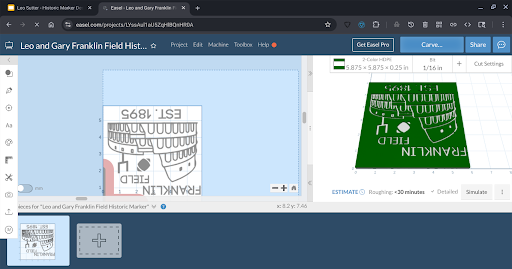
This project documents how Garret and I researched Franklin Field, translated that research into a plaque layout in Easel, and fabricated a two-color HDPE marker on a Carvey CNC machine.

We chose Franklin Field because it represents more than sports history. It is a structural and technological milestone whose legacy fits naturally into a Pre-Engineering project about design, manufacturing, and the built environment.

Scroll to case study

Project Overview

Objective, context, and project outcome.

The assignment was to choose a historic Philadelphia person, place, or event that does not already have a marker, then design and carve a plaque that could communicate its importance clearly. We selected Franklin Field because it offered both historical depth and a strong engineering connection.

The final result was a 6" x 6" two-color HDPE plaque designed in Easel and carved on a Carvey CNC machine. The project combined research, digital drafting, visual composition, and manufacturing decisions in one complete workflow.
Why Franklin Field Matters

A stadium whose legacy includes structural and technological milestones.

Historic significance

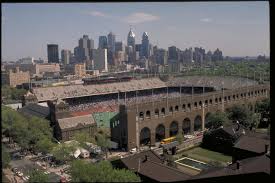
Franklin Field is one of the most important athletic sites in Philadelphia, but it is often left out of conversations about the city's landmarks. That makes it a strong subject for a commemorative plaque: it has real historical value, yet it is not always given the public recognition it deserves.

More than a sports venue

We chose Franklin Field because its importance comes from design progress as much as sports tradition. Its development reflects how engineers and builders solve problems related to scale, visibility, infrastructure, and the experience of large public spaces.

  • Second deckOne of the first college stadium expansions of its kind
  • ScoreboardAn early example of stadium information technology
  • Artificial turfA major shift in sports-surface engineering in the NFL era
  • LegacyA pattern of innovation that made the site worth commemorating

Engineering Decisions

Designing for contrast, manufacturability, and clear communication.

Why two-color HDPE helped

Two-color HDPE was a strong material choice because it created clean visual contrast between the surface and the carved areas. That mattered for a plaque that depended on readable text and simple graphics rather than color variety or decorative detail.

What the machine forced us to consider

Because the plaque was only 6" x 6", spacing and line thickness mattered. Small features had to stay large enough to carve clearly, and the overall layout had to avoid crowding so that the finished result would not lose detail in production.

From sketch to physical object

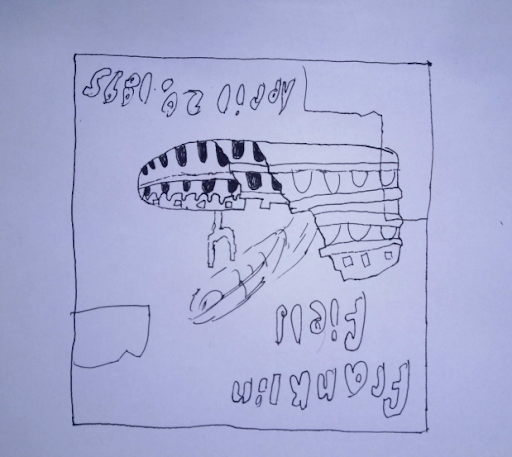
The hand-drawn concept captured the basic idea, but the Easel version required more controlled alignment, stronger hierarchy, and cleaner shapes. That translation step was important because a design can look acceptable on paper while still needing revision to work as a carved object.

Design Features

Building a formal marker with recognizable stadium imagery.

A plaque that reads quickly and feels official

We aimed for a traditional graphic layout instead of a crowded poster-like design. That choice made the plaque feel more appropriate for a commemorative marker and helped keep the text and imagery organized once the design moved into Easel.

Title Construction date Field goal post Football motion Balanced composition
  • The title establishes the subject immediately.
  • The construction date anchors the plaque historically.
  • The field goal post reinforces the identity of the site.
  • The football creates movement so the design does not feel static.
  • The formal composition keeps the plaque readable when carved.

Process Timeline

How the concept moved from research to CNC fabrication.

01

Selecting the subject

We compared possible Philadelphia subjects and chose Franklin Field because it was historically important, connected to engineering, and less obvious than many better-known sites.

Result: The project gained a topic that supported both historical research and engineering analysis.

02

Planning a layout that could actually be carved

We organized the title, date, and football-related imagery into a formal plaque format rather than a loose illustration.

Challenge: The composition needed visual energy without becoming too crowded for a small CNC plaque.

03

Refining the drawing in Easel

The sketch was translated into Easel and adjusted for spacing, alignment, and hierarchy so the machine-ready file would carve more cleanly.

Adjustment: Shapes and text placement had to be simplified and organized more carefully than in the original sketch.

04

Producing the plaque on the Carvey CNC

The final design was carved from two-color HDPE, turning the research and Easel file into a physical object with real material and production constraints. We intentionally carved the design upside down because the clamp created a negative-space area that would have landed in the bottom-left corner in the original orientation.

Constraint: Rotating the plaque moved that constrained area to the top right, where it interfered less with the layout and kept the stadium graphic clear in the bottom left.

Outcome: That tradeoff let us fit the full composition more cleanly and showed how design decisions on screen directly affect the quality of a manufactured result.

Reflection

What this project taught me about engineering workflow and design judgment.

Technical learning

I learned how CNC operation depends on preparation, not just machine use. File setup, spacing, material contrast, and readable geometry all affect whether a design works once it is carved.

From idea to manufacturing

I gained a stronger understanding of the Easel workflow and of the engineering design process itself: research, concept development, revision, production, and evaluation.

What I would improve next

If I developed a second version of this plaque, I would refine the composition even further so the hierarchy between the title, date, and imagery is even stronger in the final carved piece.

Conclusion

A project that combined local history, design communication, and real fabrication constraints.

This project worked because it did more than summarize a famous place. It required research, careful design choices, and the ability to translate an idea into something that could be manufactured accurately.

By focusing on Franklin Field, the plaque connects Philadelphia history to engineering thinking. It shows how a student project can document significance, communicate visually, and produce a finished object through a complete digital-to-physical workflow.

Works Cited

Simple MLA sources used to support the project research.